Thursday, September 1, 2011

A Couple Quick Clips of Kuntao Mantis (Silat Tua):
In this clip, Pakcik Zainal is giving a brief demonstration of Kuntao Mantis. Various Chinese arts and animal styles fall within the umbrella of Silat Tua under the title of Kuntao (Kuntau).
This clip gives a few applications for Mantis techniques.
Wednesday, August 31, 2011
Its Been a Long Time...
...since I posted anything here. My father passed away a little before Christmas last year and my mother spent some time in the hospital with some health issues. We moved around the same time...which was sooner then we had been planning. It seems our landlord had decided to stop paying on the mortgage of the house we were living in. We found out when the lender came and posted paperwork on the front door. We managed to relocate down in the greater Portland area, in a much better (and cheaper) home than the previous, but the move set us back a great deal and we're only just digging ourselves out. I've had issues with my back. I think they are slowly resolving.
While I haven't done a huge amount of martial arts training this year, I've been actively networking with various people, mostly via Facebook, here in the States and abroad...primarily in Britain and Malaysia. As I haven't really found a silat teacher here in the Portland area that I wish to train with, I'm devoting my efforts to distance training. I'll be taking my first test here very soon (as soon as I can sit down and figure out the camcorder we bought, and how best to film my test) in Pendekar William Sanders' Pencak Silat Pukulan Cimande Pusaka. Additionally, I've begun training in Guru Tuan Hj. Zainal Abidin Bin Shaikh Awab's Persatuan Silat Tua Pulau Pinang. Pakcik Zainal is a respected Malaysian teacher who offers a cluster of family arts gathered under the banner of Silat Tua, running the gamut from Malay, Southern Thai (Pattani) and Indonesian silat styles to Muay Thai and other traditional Thai arts like Muay Seah Khao ("White Tiger") and Krabi Krabong. He's very graciously agreed to teach me across the miles and accepted me into his martial family.
I will have much more to say about all of this in the next week or two, as I am going to be starting a study group here in the greater Portland area! Its always more fun and interesting, in my opinion, to be able to practice martial arts with other, like-minded people. So keep an eye out for the details...
Saturday, September 4, 2010
Haven't Been Blogging...
...for months now. I just didn't feel like it. Its been a rough year. I had bouts of pneumonia and pleurisy, and shingles. Perenially tired. Financial worries. PTSD issues that I'd managed to dodge for quite some time caught up to me. Things are looking a bit better now, and I'm feeling happier and a lot more optimistic than I have in a long time.
We'll be moving down into the Portland Metro area at the end of the month. That'll take a big chunk of time off my daily commute, plus save on wear-and-tear on the car and fuel. We expect to cut our rent by several hundred dollars a month, which will translate into paid-off bills and money in savings. We'll also have much easier access to services for our son, friends, shopping, and entertainment.
On the martial front, I haven't been very active. My stamina was shot after the illnesses and its been slow to return. I have been doing a lot of looking and reading and thinking, in regards to the martial arts. I've been in contact with a number of people in the silat community, both here in the States and overseas, especially in Malaysia. I'm looking forward to completing this move. I'm starting to practice again on my own, working to get in shape. Cimande and harimau silat, primarily. Some baji quan foundational exercises, and some kunlun quan. When we get settled in down south, though, I am going to start up a study group and see if I can get a group of people together to train and learn from one another, work with some of the distance training that's out there. I'm also going to be trying out the Kunlun Awakening process with some of Max's people in Portland. I think it will be a good thing.
I have a number of articles I'll be writing and posting on here in weeks to come. There will also be information forthcoming on the Portland Study Group once the move is behind me.
Thursday, May 6, 2010
Burmese Fighting Arts
We're living in an exciting time for martial arts researchers. The internet and electronic media formats have opened up the whole world to us. Here is a neat video clip of demonstrations of Bando. It contains various styles, from the traditional to the more modern and showy. It's worth watching all the way through, since the really interesting (in my opinion) is nearer the end.
Sunday, May 2, 2010
The Indoor Yang Family System on the Internet
This is a little off-topic, but:
I have just started another blog in which I will lay out the forms and other material in the Indoor Yang Family System:
http://indooryang.blogspot.com/
I have so far put up the first section of the Little Nine Heavens form. I should be able to put up one or two movements each day.
I will still be publishing the books. This will give you the opportunity to work with the material before the books come out, and it will help me to sort out any errors, missing information and to find which areas need clarification.
So far I have published the Wise Hammers form book. It's available from Lulu.com, and also for a much better price from Plum Publishing.
Saturday, April 17, 2010
Muay Thai Chaiyuth
By Mas Jonty

Here at the Golden Flower Warriors' Association, we have been spending some time researching the traditional martial arts of Thailand recently. There's some fascinating material that has become available recently. It may offer the "missing link" between the disparate elements of the SE Asian martial arts -- especially between the fighting arts and the sport arts.
I'm currently studying a series of DVD's that go by the name "Muay Thai Chaiyuth". The last word is usually spelled "Chaiya", so I was delighted when I stumbled upon these videos.
Above is a screenshot of one of their more extreme postures, from a sort of "peacock dance" performed traditionally before a match. Below is a shot of one of their training sequences, which match Muay Thai but also could come from Okinawan or Chinese arts.

I'll be posting more as I break down and analyze the DVD series.
Thursday, March 4, 2010
Traditional European Martial Arts: Jogo do Pau
For a long time, everyone has looked to Asia for martial arts, but there is a growing interest in local martial traditions all over the world. Here is a German documentary on the Portuguese art of Jogo do Pau. A stick-fighting art with its roots in the Middle Ages, it has been attracting attention and gaining respect in recent years. If I'm not mistaken, it may be a derivative of combat with the Medieval greatsword. Be warned...the clip is in German. For those who are interested, here is an English language website with some information on the art. Wikipedia offers information and links. This is the English version of a Portuguese website. The Dog Brothers are taking an interest in the art, and there are a video and book available, as well.
Friday, January 29, 2010
Rules and Fighting: The Paradox of Martial Arts Training
Here is a problem that is faced in every martial art:
1) At some point, you must train realistically (e.g. full-contact.)
2) Realistic fighting is dangerous, so you must either risk serious injury or develop rules.
3) Rules change the nature of fighting.
4) At some point, the practitioners forget that their rules-based fighting isn't real fighting.
Brazilian Jiujutsu fighters (who should be respected for their dedication to full-contact training) forget that outside the ring the ground is a bad place to be.
On the other end of the spectrum, Chinese wrestlers, knowing that the ground is death on the street, set rules so that you lose the fight as soon as anything knees or above touches the ground. For an Indo fighter like me, knees-on-the-ground means that I have two more ranges to fight in before I hit the ground.
Western boxers are famous for breaking their knuckles the first time they punch someone in a bar. Judoka are lost without lapels to grab. Karateka are easily defeated by a little grappling and stalking. Have I left anyone out?
What to do? The obvious solution is to keep reminding ourselves that we are playing. I make a point to use the word play quite a lot in my teaching. I play the sword and spear, we play sambutan, etc. The Filipinos have a word, Labanlaro (I think), which means "Cubs Playing". The idea being that tiger cubs, for example, play with each other more-and-more -roughly until one of the yelps, and then they separate and start over. Then the mother tiger drags home a slightly-injured wildebeast, and they take turns trying to take it down under her watchful eye, all in the safety of the den.
Saturday, December 26, 2009
More on how to practice.
Here's another article from an old master, talking about how you should train:
http://ezine.kungfumagazine.com/ezine/article.php?article=591
I found this article on Eric Ling's wonderful blog.
He doesn't sound hopeful about the martial arts, but he does talk about how the form is a receptacle for the art, not the art itself. If you want to understand the art, you have to:
Deconstruct the form, examine and practice each movement, both by itself and in combination with other movements.
Change the movement, combine upper body with different footwork.
Explore how the movement works against an opponent in different situations.
That is Kung Fu.
Sunday, December 20, 2009
Kunlun...Pai?
by Jonty
Eric Ling (http://eric88ling.wordpress.com/) has just posted about one of the Kunlun VCD's that we are researching. He has classified it as "Kunlunpai," rather than "Kunlunquan."
For those of you just tuning in, one of the goals of this blog is to research a group of martial arts named after the Kunlun mountians. I learned a system called "Kunlun Mountain Fist," that shares several forms with a set of VCD's (available from Plum Publications here.) In the VCD's, Master Huang names the system Kunlun Quan (Fist), but that doesn't mean much, since "Fist" can just refer to a system, rather than the name of this particular system.
Eric Ling, who has a wonderful blog mostly on Fukien White Crane and Hakka styles, labels one of the VCD's, the "Bandit" Fist, as Kunlunpai. He has also claimed he has several old manuscripts about these styles. Very exciting.
Saturday, December 19, 2009
Its Important to Enjoy Your Martial Arts Practice...
by Steven
...and this man obviously does. He is Guru Bang Husin, the Pewaris (grandmaster) of Pencak Silat Golok Seliwa Betawi. A rare, traditional style from the area of Jakarta, the Indonesian capital, on the island of Java. I hope people are trying to save what men like this have to teach...
...and this man obviously does. He is Guru Bang Husin, the Pewaris (grandmaster) of Pencak Silat Golok Seliwa Betawi. A rare, traditional style from the area of Jakarta, the Indonesian capital, on the island of Java. I hope people are trying to save what men like this have to teach...
Friday, December 18, 2009
Real Training in the Chinese Arts
By Jonty
I just ran across an interview of Yang Fukui, a member of the Yang family who is known for his fighting prowess in full-contact competitions. I was immediately gratified to read that his training didn't consist of long forms, but rather of the individual movements in different combinations. This supports my arguments that modern Chinese arts are too focused on memorizing the forms and often fail to escape them. Here's a quotation (He's talking about Yang Banhou and Yang Jianhou, second-generation masters):
"First of all, they devoted most of their practice to gongfu and martial arts, not to health or “spiritual development,” although these two latter aspects certainly underlied their practice. Their emphasis was different. For example, they never practiced more than a two or three form or movements in sequence, in order to develop fighting skill and gongfu, and they never linked more than five forms together. There were no such things as the 24 or 85 or 108 form Taijiquan."
The entire article can be read here.
Thursday, December 17, 2009
Working the Other Side of the Coin...
By Steven
The other side of the coin in the warrior arts, from martial pursuits, is to practice healing arts. I'm going to be working on this a lot more in days to come.
I'm doing a lot of Qigong these days. More than I have in years. And it is good.
I am starting to work on learning some acupressure/energywork and reflexology. My wife has a hypothyroid condition, and suffers from a lot of pain in her right ankle (from when it fractured in three places some years ago), and in her right hip (courtesy of a mild-to-moderate hit-and-run incident many years ago). She's also been having a problem with sensations of extreme heat in her feet for a couple or three years. Painfully hot. At the same time, other sensations in the soles of her feet have felt muted.
I've been compiling information from books we own (that have mostly been gathering dust) and decided to try out some of their suggestions. So...
I worked on the acupressure points Kidney 3 and Spleen 5, and did some reflexology work on her feet. I concentrated, based on what I knew about her conditions and the feedback she was giving me, on the areas of her feet that represent her thyroid, hips, and sciatic nerve. We also discovered that she was reacting to the areas for the solar plexus and eyes, so I added those to the list. Lastly, I worked on her Lung 1 acupressure points, since I've been experiencing benefit from that for myself. It seemed prudent, at that point, to say 'enough' for today.
We evaluated the results:
- Her ankle went from a 6.5-7.0 (on the pain scale, and she is pretty fair in her use of it) and it went to a 3.5-4.0.
- Her hip/back went from negligible at rest/9.0 while standing for extended periods to essentially pain free, at least for the moment.
- The heat issue with her feet, which I had not set out to address went from hot to cool, and the sensations feel less muted/more normal. This was an inadvertant and unexpected benefit.
- She feels more alert, and relaxed. Anxiety levels, which have been a problem, are decreased.
- She's had a twitch in her left eyelid for a couple of months. It has stopped, at least for the moment.
- The work with Lung 1 caused her shoulders to drop and made breathing easier and more relaxed.
I fully expect for these issues to require frequent follow-up, but am excited to see how things progress with time. I noticed, while doing the reflexology, that the areas being worked often gave a crackling sensation under my hands and fingers...like the shrinkwrap-sort of material they put around cigarette packs. Eventually that feeling would abate, and I'd move on to another spot.
I'm going to try and keep a record of what I (and we) are doing. I think we'll be better able to track what works, and what doesn't. We have a lot more health issues and changes we are going to be addressing over the next year. It'll be interesting to see what happens.
FOLLOW-UP: At 4 to 5 hours past the event, hip and back pain when standing for a prolonged period rates a 5.5-6.0, which is still an improvement over what it was before. I'm hoping that with frequent repeats, the chronic pain will improve on a more permanent basis.
18 December: My wife's right foot and ankle are routinely swollen, and full ROM has been missing in ankle, foot and toes since the fractures "healed". Upon arising this morning (and waking up...lol), my wife noted that there was little, if any, swelling in her ankle/foot, and she had much increased ROM. This is really exciting, and gives me hope that with a steady Tx plan using these methods, and a few others, we may be able to relieve many of her symptoms without having to resort to surgery, which was what we've feared for some time. She is not pain-free, but it has not been as bad as before, so far. The only real side effect we're seeing is that the soles of her feet are a bit tender from my working on them, but it isn't too bad.
PLEASE NOTE: I am not advocating that you, the reader, follow any of the treatments/modalities I am recording. These are not 'recommendations', but 'observations'. Any form of medical treatment should be done under the supervision of trained professionals. Your potentially poor and/or harmful choices are your own, as are mine...Sunday, December 13, 2009
Stonehenge and Silat...
By Steven I watched a fascinating show on the History Channel yesterday. MysteryQuest covered recent investigations into the possible acoustic properties of Stonehenge. A careful examination of the stones revealed that they are curved on one side, suggesting that they had an auditory function. Experiments performed by the team both at Stonehenge, and at a replica in Maryhill, Washington, revealed that percussive sound, such as drumming, if done at the correct rate, would be echoed and amplified by the stones of the site. These sounds fell in the range for Alpha waves, one of the two types of waves conducive to the production of altered states of consciousness in humans.
Further testing in a clinical environment showed that human brains would actually synchronize with the sounds produced at the site. They began to respond almost immediately. Studies of people listening to techno music at raves have demonstrated that ravers heartbeats synchronize with the beat of the music. I think that there is a correlation in some of the newer music used amongst Evangelical Christians. I've noticed there is a certain repetitive rhythm to quite a few of the songs, usually in guitar playing. It seems similar to that used in shamanic drumming, though I'm no expert. My wife once accompanied her sister's family to such a concert, and she felt herself getting “spacey”. When she realized this, the effect abated, just as it did for the investigators on the show, at one point.
Cultures around the world work to produce altered states of consciousness in the course of religious worship and esoteric practices. It would seem that this was the case at Stonehenge. Many cultures use psychoactive herbs and fungi in their rites. There is evidence that both marijuana and henbane were growing in Great Britain during the period Stonehenge was in use. Both would intensify and aid achievement of altered states. Another tool available to these ancient people was light. Additional experimentation during the show found that the sounds produced, bouncing off the stones, could affect the flicker of open flames, causing a rather strobe-like effect. We know that strobe lights can initiate seizures in epileptics, so it is appears obvious that this would have been another amplifier for altered states, especially for those closest to the center of the circle.
 The show made me think about the way Silat is often practiced in Indonesia. To the accompaniment of a gamelan orchestra. Gamelan has a great deal of percussive rhythm, and it tends to be fast and rather repetitive. Again, this is similar to shamanic drumming. Its not uncommon for it to be practiced at night, by firelight (traditionally). Traditional Indonesian culture, and Silat, are known for initiating trance states, animal and spirit possession in individuals. There is even a practice (classed as a form of ilmu), in some systems, in which one attempts to contact and be influenced (kaeunteupan) or possessed (sambatan, or “ridden”, to borrow a Vodun term) by one's Silat ancestors. Jurus(short forms) practice can be thought of as talari karuhan, a “rope” or connection to the style's ancestors. A side note to this idea...that specific postures could create a link to previous practitioners, is extremely interesting in light of research done by the late Felicitas Goodman and the Cuyamungue Institute. She did considerable research into glossolalia, possession and trance states, and found that the use of certain postures (found in ancient paintings and sculptures) tended to produce specific types of visual and auditory phenomena in people who are in an altered state of consciousness (she also found the link to certain specific rates of drumming aiding in the achievement of these states). I don't think she did research into martial stances of South Asia, or into the the religious poses, dance postures and mudras of the region. Most of her work concentrated on Neolithic and Native American material, I believe. I suspect that some of the postures found in Silat could (and do) produce certain results, if done in an altered state. And I suspect that traditional, old school Silat training is designed to do just that. The belief is that kaeunteupan and sambatan enhance and accelerate one's learning, and goodness knows they didn't have a decade or two to produce quality warriors. I'd like to see some study of this in the future, before all the traditional styles are gone, stamped out by conservative Islam or absorbed into modern sport Olah Raga and the push for Olympic gold.
I also suspect that we are seeing just one aspect of an ancient technology, predating that of the modern world. After all, we have only been agrarian and “civilized” for a few thousand years. We were hunter-gatherers for tens of thousands of years, and its a well-documented fact that such cultures require only about 20+/- hours of work per week from its members. In his novel Tropic of Night, Michael Gruber questioned what they did with all that spare time, and suggested that they developed a sophisticated technology involving the use of herbs, phytochemicals and altered states. It makes a certain amount of sense to me, and its something worthy of greater study.
For anyone interested in more information about the research on Stonehenge and sound, here are some links...
http://soundsofstonehenge.wordpress.com/category/uncategorized/
http://aphroditeastrology.com/2009/12/stonehenge-spiritual-transcendence-tool.html
http://www.livedash.com/transcript/mysteryquest-(stonehenge)/71/HISTP/Thursday_December_3_2009/116367/
http://2012forum.com/forum/viewtopic.php?f=9&p=211077
http://mysticbeats.com/Home.php
 I watched a fascinating show on the History Channel yesterday. MysteryQuest covered recent investigations into the possible acoustic properties of Stonehenge. A careful examination of the stones revealed that they are curved on one side, suggesting that they had an auditory function. Experiments performed by the team both at Stonehenge, and at a replica in Maryhill, Washington, revealed that percussive sound, such as drumming, if done at the correct rate, would be echoed and amplified by the stones of the site. These sounds fell in the range for Alpha waves, one of the two types of waves conducive to the production of altered states of consciousness in humans.
Further testing in a clinical environment showed that human brains would actually synchronize with the sounds produced at the site. They began to respond almost immediately. Studies of people listening to techno music at raves have demonstrated that ravers heartbeats synchronize with the beat of the music. I think that there is a correlation in some of the newer music used amongst Evangelical Christians. I've noticed there is a certain repetitive rhythm to quite a few of the songs, usually in guitar playing. It seems similar to that used in shamanic drumming, though I'm no expert. My wife once accompanied her sister's family to such a concert, and she felt herself getting “spacey”. When she realized this, the effect abated, just as it did for the investigators on the show, at one point.
Cultures around the world work to produce altered states of consciousness in the course of religious worship and esoteric practices. It would seem that this was the case at Stonehenge. Many cultures use psychoactive herbs and fungi in their rites. There is evidence that both marijuana and henbane were growing in Great Britain during the period Stonehenge was in use. Both would intensify and aid achievement of altered states. Another tool available to these ancient people was light. Additional experimentation during the show found that the sounds produced, bouncing off the stones, could affect the flicker of open flames, causing a rather strobe-like effect. We know that strobe lights can initiate seizures in epileptics, so it is appears obvious that this would have been another amplifier for altered states, especially for those closest to the center of the circle.
 The show made me think about the way Silat is often practiced in Indonesia. To the accompaniment of a gamelan orchestra. Gamelan has a great deal of percussive rhythm, and it tends to be fast and rather repetitive. Again, this is similar to shamanic drumming. Its not uncommon for it to be practiced at night, by firelight (traditionally). Traditional Indonesian culture, and Silat, are known for initiating trance states, animal and spirit possession in individuals. There is even a practice (classed as a form of ilmu), in some systems, in which one attempts to contact and be influenced (kaeunteupan) or possessed (sambatan, or “ridden”, to borrow a Vodun term) by one's Silat ancestors. Jurus(short forms) practice can be thought of as talari karuhan, a “rope” or connection to the style's ancestors. A side note to this idea...that specific postures could create a link to previous practitioners, is extremely interesting in light of research done by the late Felicitas Goodman and the Cuyamungue Institute. She did considerable research into glossolalia, possession and trance states, and found that the use of certain postures (found in ancient paintings and sculptures) tended to produce specific types of visual and auditory phenomena in people who are in an altered state of consciousness (she also found the link to certain specific rates of drumming aiding in the achievement of these states). I don't think she did research into martial stances of South Asia, or into the the religious poses, dance postures and mudras of the region. Most of her work concentrated on Neolithic and Native American material, I believe. I suspect that some of the postures found in Silat could (and do) produce certain results, if done in an altered state. And I suspect that traditional, old school Silat training is designed to do just that. The belief is that kaeunteupan and sambatan enhance and accelerate one's learning, and goodness knows they didn't have a decade or two to produce quality warriors. I'd like to see some study of this in the future, before all the traditional styles are gone, stamped out by conservative Islam or absorbed into modern sport Olah Raga and the push for Olympic gold.
I also suspect that we are seeing just one aspect of an ancient technology, predating that of the modern world. After all, we have only been agrarian and “civilized” for a few thousand years. We were hunter-gatherers for tens of thousands of years, and its a well-documented fact that such cultures require only about 20+/- hours of work per week from its members. In his novel Tropic of Night, Michael Gruber questioned what they did with all that spare time, and suggested that they developed a sophisticated technology involving the use of herbs, phytochemicals and altered states. It makes a certain amount of sense to me, and its something worthy of greater study.
For anyone interested in more information about the research on Stonehenge and sound, here are some links...
http://soundsofstonehenge.wordpress.com/category/uncategorized/
http://aphroditeastrology.com/2009/12/stonehenge-spiritual-transcendence-tool.html
http://www.livedash.com/transcript/mysteryquest-(stonehenge)/71/HISTP/Thursday_December_3_2009/116367/
http://2012forum.com/forum/viewtopic.php?f=9&p=211077
http://mysticbeats.com/Home.php
Indo-Malay Snakes and Their Names...
By Steven
About three years back, I came across a book at the library entitled Venomous and Poisonous Animals and Noxious Plants of the Pacific Region, edited by Hugh L. Keegan and W.V. MacFarlane (MacMillan & Co, NY 1963). Always interested in things like this, I checked it out. I was surprised to find that it gave local names to a number of the venomous snakes in the Indo-Malay area. While these don't have much to do with Silat, these are names that are largely unavailable in the common Indonesian and Malayan dictionaries, so I copied them down. I just came across the paper, which was dying, and decided to make the information available here. So, without further ado:
About three years back, I came across a book at the library entitled Venomous and Poisonous Animals and Noxious Plants of the Pacific Region, edited by Hugh L. Keegan and W.V. MacFarlane (MacMillan & Co, NY 1963). Always interested in things like this, I checked it out. I was surprised to find that it gave local names to a number of the venomous snakes in the Indo-Malay area. While these don't have much to do with Silat, these are names that are largely unavailable in the common Indonesian and Malayan dictionaries, so I copied them down. I just came across the paper, which was dying, and decided to make the information available here. So, without further ado:
Common cobra: ular sendok (Indonesia); ular tedong sendak (Malay); ular bedul (Malay); ular biludah (Padang Highlands, Sumatra); oraj sendok (Sundanese); hantipeh pura (Dayak).
King cobra: ular anang (Java).
Yellow-headed krait: ular tanjon api (Sumatra).
Banded krait: oraj welang (Sundanese); ular welang (Malay); ular katam tabu (Malay); ngu sam liem (Thai).
Malayan krait: oraj weling (Sundanese); ular weling (Malay).
Malayan pit viper: ular biludak (Java); ular tanah (West Java); ular gebuk (West Java); ular bandotan bedor (Central Java); ular bedudak (West Java); ular lemah (West Java); ular kapac daun (Malay).
Sumatran pit viper: ular bisa (Sumatra).
Wagler's pit viper: ular puckuk (Sumatra); ular bakaw (Malay).
Common long-glanded snake: ular cabe (Java); ular kapala dua (Sumatra); ular cabeh (Malay).
Red-bellied long-glanded snake: oraj cabeh (Java); ular cabeh (Malay); ular sina matahari (Malay); ular tedong matahari (Singapore); kendawang (Dayak).
Friday, December 11, 2009
Silat in America: Where are the Pure Styles?
By Mas Jonty
Interest in Pencak Silat is growing furiously here in the U.S.A. Almost weekly, new teachers are popping out of the woodwork. However, there is a puzzling question:
Where are all the pure styles? It seems that almost every teacher of Indonesian martial arts in the U.S. is teaching their own personal "Kuntao" blend of different styles. You won't find a pure Cikalong teacher, or a straight Cimande teacher. Even the supposedly pure styles being taught over here seem to be modern Dutch/Indo blends. What gives?
Before we try and answer that question, I'd like to note that I think this is can be a blessing and a curse: As far as I'm concerned, Willem DeThouars can make up his own styles all he wants, but on the other hand I have seen some truly inferior arts in this category.
So I have a few possible answers to our question:
There are a lot of "multi-yellow-belt" teachers out there, and Silat is an open field for people to pass themselves off as masters.
Traditionally you would perhaps have to learn several different styles to round out your fighting skills. This fits with my understanding of the older arts. If you read the Chinese and Japanese classics, the old masters used to learn several styles on their road to mastery. Large, all-in-one styles are more of a modern invention.
Please "write in" and discuss. I'd love to hear your ideas.
Interest in Pencak Silat is growing furiously here in the U.S.A. Almost weekly, new teachers are popping out of the woodwork. However, there is a puzzling question:
Where are all the pure styles? It seems that almost every teacher of Indonesian martial arts in the U.S. is teaching their own personal "Kuntao" blend of different styles. You won't find a pure Cikalong teacher, or a straight Cimande teacher. Even the supposedly pure styles being taught over here seem to be modern Dutch/Indo blends. What gives?
Before we try and answer that question, I'd like to note that I think this is can be a blessing and a curse: As far as I'm concerned, Willem DeThouars can make up his own styles all he wants, but on the other hand I have seen some truly inferior arts in this category.
So I have a few possible answers to our question:
1) People are making up their own arts because they never finished studying any one art.
There are a lot of "multi-yellow-belt" teachers out there, and Silat is an open field for people to pass themselves off as masters.
2) Traditional Silat styles are small, modular systems that each focus on a narrow set of skills.
Traditionally you would perhaps have to learn several different styles to round out your fighting skills. This fits with my understanding of the older arts. If you read the Chinese and Japanese classics, the old masters used to learn several styles on their road to mastery. Large, all-in-one styles are more of a modern invention.
3) We have modern, left-brained methods of organizing and teaching our arts that require different approaches to styles.
Please "write in" and discuss. I'd love to hear your ideas.
Saturday, November 28, 2009
More on the Queen Mother...
By Steven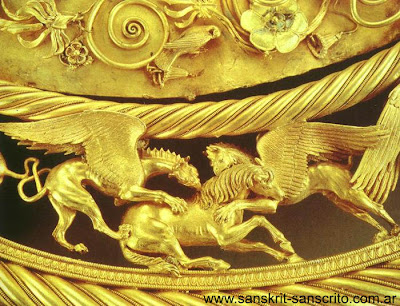 (Details of an object of Scythian artwork found in Tuva, Siberia, dating to the 4th Century BCE)
 (Details of an object of Scythian artwork found in Tuva, Siberia, dating to the 4th Century BCE)
I finally got around to looking at a book I found at a thrift store some time ago - Twilight Goddess: Spiritual Feminism and Feminine Spirituality - by Thomas Cleary and Sartaz Aziz. I realized this book would likely have something to say about Xi Wang Mu, the Golden Mother of the West. Indeed it does. While the authors discuss some of the general information about the Goddess, they also put forth an interesting theory. Given recent discoveries in the Taklamakan Desert, not far north of the Kunlun Mountains, of seemingly Caucasian "mummies", they wonder if the "Golden Mother" may not be a memory of some blonde-haired shaman-queen of these Western people. The authors believe the likeliest origin of these remains are the Scythians. The remains may date as far back as 4,000 years. These people lived between the Kunlun and Altai ranges, which should be the right location for the Scythians at that time. Ancient accounts do mention red and blond hair amongst these tribes, which were an Aryan people speaking a language similar to Iranian. Fair-haired people among the Afghans and Pakistanis, usually attributed to the army of Alexander the Great, may actually represent Scythian ancestry. Scythian-style chariots have been discovered in Chinese archaeological sites.
A major problem is that the Scythians left no written records.
But the plot thickens...
Apparently, a fair number of Irish historians claim Scythian roots for the Celtic people, pointing to long-standing Celtic traditions. If this is a valid claim, there were certainly women warriors, wizards and chieftains amongst ancient Celtic and Pictish peoples, as well as matriarchal traditions amongst some of the tribes. The authors pointed to the legends of Queen Medb (Maeve), a wealthy, powerful blonde queen with magical powers who ruled over the western fifth of Ireland (a Queen of the West?). She could induce feelings of childbirth (labor pains) in male warriors, which bears a relation of sorts to some practices and legends in Chinese Taoist beliefs (meditation is a man become 'pregnant', the Queen Mother and her representative teaching magical methods for to Chinese rulers and sages to protect themselves and their domains). Her name meant "intoxication", which can have a number of meanings at deeper levels. Neither Queen married, but both had many lovers. The idea of Xi Wang Mu holding court atop the mystical Kunlun Mountain, surrounded by Immortals and tending the Peaches of Immortality in her splendid gardens, is mirrored by Tir na n-Og, the Land of Youth that was thought to be somewhere west of Celtic lands, and was the location to which worthy people went after death (and sometimes returned from, should the people have a time of great need).
Can they prove this theory? Not unless some new "smoking gun" is dug up somewhere, one day in the future. I do think there is likely some kernel of truth there. The more reading I do, the more I seem to find that Central Asia has been "central" to much of Eurasian history.
Publication of the Kunlun Green Dragon Form!...
Shifu Jonty has recently finished his book on the Green Dragon Form of Kunlun Mountain Fist. He learned this in the mid-90's while studying with Shifu Jason Baaht. It equates, roughly, with the first quarter of the Kunlun Quan Four Directions Form (Si Xiang Quan). For anyone interested, the book is available here .
Subscribe to:
Posts (Atom)