by Jonty
Eric Ling (http://eric88ling.wordpress.com/) has just posted about one of the Kunlun VCD's that we are researching. He has classified it as "Kunlunpai," rather than "Kunlunquan."
For those of you just tuning in, one of the goals of this blog is to research a group of martial arts named after the Kunlun mountians. I learned a system called "Kunlun Mountain Fist," that shares several forms with a set of VCD's (available from Plum Publications here.) In the VCD's, Master Huang names the system Kunlun Quan (Fist), but that doesn't mean much, since "Fist" can just refer to a system, rather than the name of this particular system.
Eric Ling, who has a wonderful blog mostly on Fukien White Crane and Hakka styles, labels one of the VCD's, the "Bandit" Fist, as Kunlunpai. He has also claimed he has several old manuscripts about these styles. Very exciting.
Showing posts with label Kunlun. Show all posts
Showing posts with label Kunlun. Show all posts
Sunday, December 20, 2009

Saturday, November 28, 2009
More on the Queen Mother...
By Steven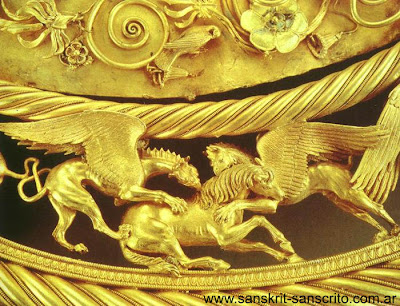 (Details of an object of Scythian artwork found in Tuva, Siberia, dating to the 4th Century BCE)
 (Details of an object of Scythian artwork found in Tuva, Siberia, dating to the 4th Century BCE)
I finally got around to looking at a book I found at a thrift store some time ago - Twilight Goddess: Spiritual Feminism and Feminine Spirituality - by Thomas Cleary and Sartaz Aziz. I realized this book would likely have something to say about Xi Wang Mu, the Golden Mother of the West. Indeed it does. While the authors discuss some of the general information about the Goddess, they also put forth an interesting theory. Given recent discoveries in the Taklamakan Desert, not far north of the Kunlun Mountains, of seemingly Caucasian "mummies", they wonder if the "Golden Mother" may not be a memory of some blonde-haired shaman-queen of these Western people. The authors believe the likeliest origin of these remains are the Scythians. The remains may date as far back as 4,000 years. These people lived between the Kunlun and Altai ranges, which should be the right location for the Scythians at that time. Ancient accounts do mention red and blond hair amongst these tribes, which were an Aryan people speaking a language similar to Iranian. Fair-haired people among the Afghans and Pakistanis, usually attributed to the army of Alexander the Great, may actually represent Scythian ancestry. Scythian-style chariots have been discovered in Chinese archaeological sites.
A major problem is that the Scythians left no written records.
But the plot thickens...
Apparently, a fair number of Irish historians claim Scythian roots for the Celtic people, pointing to long-standing Celtic traditions. If this is a valid claim, there were certainly women warriors, wizards and chieftains amongst ancient Celtic and Pictish peoples, as well as matriarchal traditions amongst some of the tribes. The authors pointed to the legends of Queen Medb (Maeve), a wealthy, powerful blonde queen with magical powers who ruled over the western fifth of Ireland (a Queen of the West?). She could induce feelings of childbirth (labor pains) in male warriors, which bears a relation of sorts to some practices and legends in Chinese Taoist beliefs (meditation is a man become 'pregnant', the Queen Mother and her representative teaching magical methods for to Chinese rulers and sages to protect themselves and their domains). Her name meant "intoxication", which can have a number of meanings at deeper levels. Neither Queen married, but both had many lovers. The idea of Xi Wang Mu holding court atop the mystical Kunlun Mountain, surrounded by Immortals and tending the Peaches of Immortality in her splendid gardens, is mirrored by Tir na n-Og, the Land of Youth that was thought to be somewhere west of Celtic lands, and was the location to which worthy people went after death (and sometimes returned from, should the people have a time of great need).
Can they prove this theory? Not unless some new "smoking gun" is dug up somewhere, one day in the future. I do think there is likely some kernel of truth there. The more reading I do, the more I seem to find that Central Asia has been "central" to much of Eurasian history.
Publication of the Kunlun Green Dragon Form!...
Shifu Jonty has recently finished his book on the Green Dragon Form of Kunlun Mountain Fist. He learned this in the mid-90's while studying with Shifu Jason Baaht. It equates, roughly, with the first quarter of the Kunlun Quan Four Directions Form (Si Xiang Quan). For anyone interested, the book is available here .
Wednesday, November 18, 2009
The Original Breath of the Great Yin...
By Steven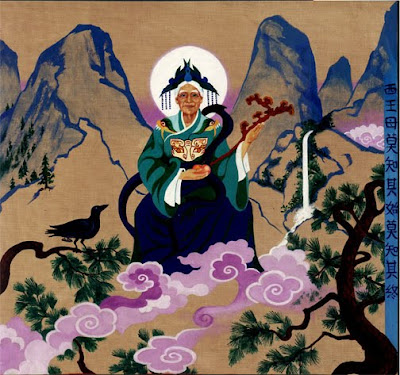
When I started to develop an interest in the Kunlun Shan, one of the things that I found interesting was the figure of Xi Wang Mu, the Queen Mother of the West, the Mother of All Creatures, the highest embodiment of Yin, and greatest of all female Taoist deities.
She dates at least as far back as the Shang Dynasty, maybe farther, one of her names being found on oracle bone inscriptions. One of her ancient names is Mother of the Golden Tortoise, a reference to the ancient practice of turtle shell divination. Xi Wang Mu appears to be a survival of China's (and Taoism's) shamanistic roots.
Yu the Great (legendary founder of the Xia Dynasty), King Mu (of the Zhou Dynasty), Qin Shihuangdi (first emperor of the Qin Dynasty), and Han Wudi (Martial Emperor of the Han) are all said to have had relations, both good and bad, with the Queen Mother of the West. It even appears that said relationship may have been important to the legitimacy and success of their reign.
She is said to dwell atop Kunlun Mountain, in her palace beside the Turquoise Pond, surrounded by her delightful flowering gardens. Xi Wang Mu guards the Peaches of Immortality, which grow on a great Tree in the garden that is said to be a ladder between Heaven and Earth used by spirits and shamans. This is clearly a World Tree/Axis Mundi symbol, and likely a survival from her shamanistic roots. She is attended by a host of Immortals and fairies, as well as her Jade Maidens. Other unusual figures associated with Xi Wang Mu include Qingnaio, a raven with three legs; a white tiger (a symbol of the West); a seven-horned white stag; a nine-tailed fox; a dancing frog, and the moon-hare. She has definite associations with birds. She may sit on leopard or fox pelts. She wore the nine-starred crown. The imagery goes on and on.
The idea that Yang (masculine energy) requires Yin (feminine energy) in order to attain Immortality or transcendence is a fundamental part of real alchemy. Contrary to the literalists, the transmutation of lead into gold was not meant to refer to actual metals, but spoke of the transformation of the base (lead) into something refined (gold, the only metal that doesn't rust/decay). Androgyny, or a balance between opposites (the Yin-Yang symbol), has long been key for those who wish to evolve, and seems to be the reason for the Goddess' prominence. This symbolism is important to the stories of the Queen Mother of the West and the various kings and emperors who had dealings with her.

When I started to develop an interest in the Kunlun Shan, one of the things that I found interesting was the figure of Xi Wang Mu, the Queen Mother of the West, the Mother of All Creatures, the highest embodiment of Yin, and greatest of all female Taoist deities.
She dates at least as far back as the Shang Dynasty, maybe farther, one of her names being found on oracle bone inscriptions. One of her ancient names is Mother of the Golden Tortoise, a reference to the ancient practice of turtle shell divination. Xi Wang Mu appears to be a survival of China's (and Taoism's) shamanistic roots.
Yu the Great (legendary founder of the Xia Dynasty), King Mu (of the Zhou Dynasty), Qin Shihuangdi (first emperor of the Qin Dynasty), and Han Wudi (Martial Emperor of the Han) are all said to have had relations, both good and bad, with the Queen Mother of the West. It even appears that said relationship may have been important to the legitimacy and success of their reign.
She is said to dwell atop Kunlun Mountain, in her palace beside the Turquoise Pond, surrounded by her delightful flowering gardens. Xi Wang Mu guards the Peaches of Immortality, which grow on a great Tree in the garden that is said to be a ladder between Heaven and Earth used by spirits and shamans. This is clearly a World Tree/Axis Mundi symbol, and likely a survival from her shamanistic roots. She is attended by a host of Immortals and fairies, as well as her Jade Maidens. Other unusual figures associated with Xi Wang Mu include Qingnaio, a raven with three legs; a white tiger (a symbol of the West); a seven-horned white stag; a nine-tailed fox; a dancing frog, and the moon-hare. She has definite associations with birds. She may sit on leopard or fox pelts. She wore the nine-starred crown. The imagery goes on and on.
The idea that Yang (masculine energy) requires Yin (feminine energy) in order to attain Immortality or transcendence is a fundamental part of real alchemy. Contrary to the literalists, the transmutation of lead into gold was not meant to refer to actual metals, but spoke of the transformation of the base (lead) into something refined (gold, the only metal that doesn't rust/decay). Androgyny, or a balance between opposites (the Yin-Yang symbol), has long been key for those who wish to evolve, and seems to be the reason for the Goddess' prominence. This symbolism is important to the stories of the Queen Mother of the West and the various kings and emperors who had dealings with her.
Tuesday, November 17, 2009
Some Kunlunquan History
[Note: This is a very rough and quick translation of some historical notes on Kunlunquan. I'm not sure where I copied the Chinese from; I'll add that in when I find out. -Jonty]
昆仑拳是旧时由一位走江湖的黄辉龙老师傅传授,
Kūnlúnquán is ancient times from a place Jianghu of Huáng Huīlong (Huīlóng or Huīlŏng) old master teacher transmitted,
[Note: Jianghu ("Rivers and Lakes") is a semi-fictional place where many traditional stories and legends are set. Not sure which pronunciation of Huáng Huīlong is correct.]
黄师傅原籍山东省省济南市人,
Teacher Huáng’s birthplace Shandong Province Jinan City,
年龄虽已60多岁, 但他白天奔 跑市, 镇, 乡村卖药,
even though he was over 60 years old, still he ran around the market, city, country villages selling medicine,
晚上传授技艺,
at night he transmitted and taught his skill and art,
由于当时官府有 “禁武令”,传艺只好闭门偷偷摸摸地进行,
because at that time there was an official “Martial Ban Decree”, he was forced to transmit his art closed-door secretly,
三更起练,五更收场,以免招祸,故传习的人数不多。
in the dead of night rise practice, early morning receive market, so as not to provoke calamity, is the reason (there are) not many (practitioners of this style)
昆仑拳是旧时由一位走江湖的黄辉龙老师傅传授,
Kūnlúnquán is ancient times from a place Jianghu of Huáng Huīlong (Huīlóng or Huīlŏng) old master teacher transmitted,
[Note: Jianghu ("Rivers and Lakes") is a semi-fictional place where many traditional stories and legends are set. Not sure which pronunciation of Huáng Huīlong is correct.]
黄师傅原籍山东省省济南市人,
Teacher Huáng’s birthplace Shandong Province Jinan City,
年龄虽已60多岁, 但他白天奔 跑市, 镇, 乡村卖药,
even though he was over 60 years old, still he ran around the market, city, country villages selling medicine,
晚上传授技艺,
at night he transmitted and taught his skill and art,
由于当时官府有 “禁武令”,传艺只好闭门偷偷摸摸地进行,
because at that time there was an official “Martial Ban Decree”, he was forced to transmit his art closed-door secretly,
三更起练,五更收场,以免招祸,故传习的人数不多。
in the dead of night rise practice, early morning receive market, so as not to provoke calamity, is the reason (there are) not many (practitioners of this style)
[Note: The Chinese used to divide the night into two-hour segments called "更" or "changes". "三更" means "Third change", and is often used to refer to the middle of the night. "五更" Would be the very early hours of the morning.]
解放后,昆仑拳得以新生,建国以来在丰顺传授昆仑拳的有丘展华师傅。
After liberation, Kūnlúnquán became newborn, establish nationally in order to return to Fengshun [county in Shandong] transmit teach Kūnlúnquán’s have name open illustrious (possibly name Qiu Zhanhua) teacher.
[Note: I think "Kunlunquan has a name for open and illustrious teachers" is close to the meaning, but it may be something like "Kunlunquan has named Qiu Zhanhua as teacher". ]
昆仑拳流传丰顺, 揭阳, 揭西,近年来深圳, 珠海两市均有传人。
Kūnlúnquán circulate transmit Fengshun , bring out into the light, divulge to the West, recently return to Shenzheng, Zhuhai both towns equally have teachers.
Kūnlúnquán circulate transmit Fengshun , bring out into the light, divulge to the West, recently return to Shenzheng, Zhuhai both towns equally have teachers.
昆仑拳的风格特点:眼巧, 心灵随变化,要求练习者,攻击时凶猛, 刁滑,讲究吞, 吐, 浮, 沉,每发招出手均要 向对手要害部位攻击,桩马较高,发招呼气收招吸气。 Kūnlúnquán’s Wind Style Special Points: Eye clever, Heart/mind follows changes, demands practicer, attack strike now fierce and abrupt, cunning and slippery, explain study carefully swallow and spit, float and sink, each issue send out hands equally demand toward facing/correct hand demand injure place attack beat (each time you send out your hands you must injure what you attack), stake horse higher, issue provoke exhale, gather provoke inhale.
Si Xiang Quan - A Kunlunquan Form
This is the Four Directions Form, as demonstrated by Huang Shuangqing, a Kunlunquan practitioner in Shandong Province, China. Jonty learned a similar version of the form in Kunlun Mountain Fist.
Da Luoquan - An East Kunlunpai Form
Here is a clip of the "Rollback" Form from the Eastern branch of the Kunlunpai. So far, I've been unable to find out who the practitioner is, or where this was filmed. But I like it.
Monday, November 16, 2009
A Little Background on Kunlun...

The Kunlun Mountains (崑崙山) form one of the longer mountain ranges in Asia, stretching for some 3,000 km between Tibet (to the south) and the Tarim Basin, Takla Makan and Gobi Deserts (to the north). The highest point in the range is the mountain Kunlun Goddess, at 7,167 meters. They are one of the Earth’s remote places, and are only crossed by roads in two places. Kunlun is famous for its jade, and was the source of the Jade Road, an ancient set of trade routes, stretching as far as the Mediterranean, SE Asia, and China, and predating the more famous Silk Road by millennia.
There are five sacred mountains in Taoist cosmology. Pride of place, the center, goes to Kunlun. It is considered the central axis of the Taoist universe. Shrouded in clouds and mist, dangerous and mysterious, its high peaks are a symbol of the unknowable Tao, as well as a symbol of the link between Heaven and Earth, body and spirit. Kunlun is also believed to be the Taoist Paradise (Shangri-La?) and the home of Xi Wang Mu (西王母), the Queen Mother of the West, an ancient Chinese goddess who lived atop Kunlun in her palace, tending the Peaches of Immortality. It was believed, in the past, that Kunlun could move about at will, that it existed both within and without the world, that it was everywhere and nowhere.
Together with Shaolin, Wudang, Ermei, and Kongdong, Kunlun is considered one of the five major martial schools of China. Kunlun is known for its skills with the sword. There are a number of Taoist sects and martial traditions associated with the Kunlun Mountains. Of course, claiming a connection to distant Kunlun is similar to ascribing your art to a nameless Taoist hermit or monk in the mountains (or to Bodhidharma, for that matter).
The arts of Kunlunquan, Kunlunpai (divided into West and East branches), and Kunlun Mountain Fist all appear related, and claim a connection disappearing back into antiquity. These styles may display a Hakka influence (though some claim the influence went the other direction). There is a strong Cannon Fist element to the arts, and there is a resemblance, in some forms, to Chen Taiji. Jonty was lucky enough to study Kunlun Mountain Fist in the mid-90’s with Shifu Jason Baaht, before his death in 1997. Clips of Kunlunquan from a set of Chinese VCD’s by Huang Shuangqing are what generated interest in the art for me. Very rare here in the West, we are currently researching the art in an attempt to find out more.
Bapak Willem de Thouars uses Kunlunpai in the title of his Kuntao Silat organization, but ascribes a strictly symbolic reason to his choice of names. Additionally, there are Indonesian martial artists that claim a connection to the Kunlun region, dating back many centuries.
Some people claim an origin in Kunlun for Bagua, including the practitioners of Lama Dorje’s (Max Christenson) Kunlun Bliss, a system of “shaking” Qigong. No one that I am aware of has yet substantiated such claims, however. Bagua does have a Kunlun Fan Form, named in honor of Dong Haichuan, who was sometimes called the "Hero of the Kunlun Mountains".
The Muslim Chinese style of Tantui may have its origin in the Kunlun region. It is certainly a possilbility, given the Central Asian locale.
Some Taiji styles, especially Yang Michuan, have a Kunlun sword form, as does Hung Gar Kung Fu. Again, however, this is likely symbolic.
Wild Goose Qigong, or Dayan Qigong, and the related Kunlun Shan Qigong, maintain a Kunlun origin for their energetic health practices. There are Bagua-style circle walking practices found in these Qigong styles.
There are also some Youtube clips of something called Kunlun Goddess Yoga, but I don't have any information about it at this time.
There are also some Youtube clips of something called Kunlun Goddess Yoga, but I don't have any information about it at this time.
One of our aims is to increase our knowledge of these arts. Additionally, we would like to increase public interest in them, as we feel they are worthy of further study.
Subscribe to:
Posts (Atom)